

Over 82 million people have been infected worldwide, and the number of new COVID-19 cases has continued to climb in recent months. As we anxiously await vaccines, artificial intelligence is already battling the virus on a number of fronts — from predicting protein structure and diagnosing patients to automatically disinfecting public areas.
As part of our year-end series, Synced highlights 10 AI-powered efforts that contributed to the fight against COVID-19 in 2020.
AlphaFold
To help the global research community better understand the coronavirus, UK-based AI company and research lab DeepMind in March leveraged their AlphaFold system to releasestructure predictions for six proteins associated with SARS-CoV-2, the virus that causes COVID-19. In August, DeepMind released additional SARS-CoV-2 structure predictions for five understudied SARS-CoV-2 targets.
AlphaFold was introduced in December 2018. The deep learning system is designed to accurately predict protein structure even when no structures of similar proteins are available, and can generate 3D models of proteins with SOTA accuracy. On November 30, the latest version of AlphaFold was recognized for solving the biennial Critical Assessment of Protein Structure Prediction (CASP) grand challenge with unparalleled levels of accuracy. DeepMind says AlphaFold’s success “demonstrates the impact AI can have on scientific discovery and its potential to dramatically accelerate progress in some of the most fundamental fields that explain and shape our world.”

Diagnosing COVID-19 Infection in Seconds
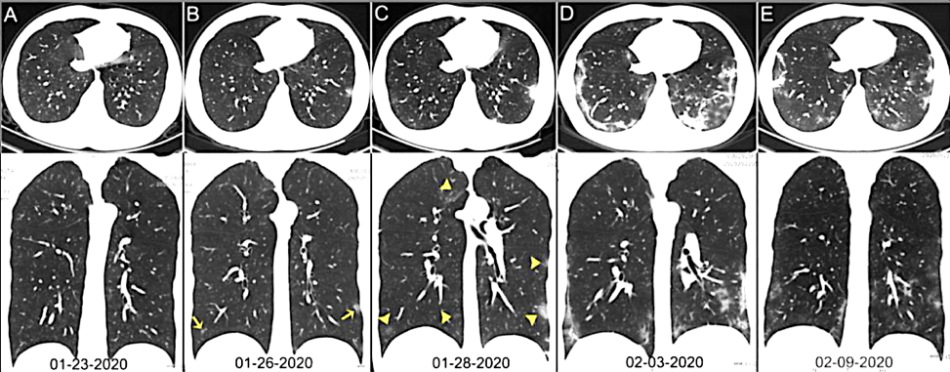
CT (computed tomography) lung scans and nucleic acid tests are the two main diagnostic tools doctors use in confirming COVID-19 infections, and CT imaging is crucial for lung infection diagnosis verification and severity assessment.
In January, the Shanghai Public Health Clinical Center (SPHCC) partnered with Chinese AI startup YITU Technology’s healthcare division — which provides AI-powered medical imaging solutions for lung cancer diagnosis — to build an AI CT image reader.
By February 5, the AI diagnostic system had been deployed in four Hubei province hospitals struggling with ongoing doctor and supply shortages. Functionalities catering to the specific needs of clinical departments such as radiology, respiratory, emergency, intensive care, etc., were built into the system.
COVID-19 Open Research Dataset Challenge
In response to the COVID-19 pandemic, the US White House joined with research groups in March to announce the release of the COVID-19 Open Research Dataset (CORD-19) of scholarly literature about COVID-19, SARS-CoV-2, and the coronavirus group. The release came with an urgent call to action to the world’s AI experts to “develop new text and data mining techniques that can help the science community answer high-priority scientific questions related to COVID-19.”
The online ML community Kaggle is hosting a CORD-19 dataset challenge that defines 10 tasks based on key scientific questions developed in coordination with the WHO and the National Academies of Sciences, Engineering, and Medicine’s Standing Committee on Emerging Infectious Diseases and 21st Century Health Threats.
Folding@Home
Developed by the Pande Laboratory at Stanford University in 2000 as a distributed computing project for simulating protein dynamics — including the process of protein folding and the movements of protein implicated in a variety of diseases — the Folding@Home project aims to build a network of protein dynamics simulations run on volunteers’ personal computers to provide insights that could help researchers develop new therapeutics.
The current focus of Folding@Home is modelling the structure of the 2019-nCoV spike protein to identify sites that can be targeted by therapeutic antibodies. Coronaviruses invade cells via spike protein on their surfaces, which binds to a lung cell’s receptor protein. Understanding the structure of viral spike protein and how it binds to the ACE-2 human host cell receptor can help scientists stop viral entry into human cells. Anyone who would like to donate their unused computing power can join Folding@Home’s fight against the coronavirus.

COVID-Net
In March, Canadian startup DarwinAI released COVID-Net, an open-sourced neural network for COVID-19 detection using chest radiography (X-Rays). Company CEO Sheldon Fernandez says COVID-Net has been leveraged by researchers in Italy, Canada, Spain, Malaysia, India and the US.
Fernandez explains that rather than treating AI as a tool, his company reimagines AI as a collaborator that learns from a developer’s needs and subsequently proposes multiple design approaches with different trade-offs in order to enable a rapid and iterative approach to model building.
Covid-Sanity
In response to the COVID-19 pandemic, Andrej Karpathy — director of artificial intelligence and Autopilot Vision at Tesla and developer of the arXiv sanity preserver web interface — introduced “Covid-Sanity,” a web interface designed to navigate the flood of bioRxiv and medRxiv COVID-19 papers and make the research within more searchable and sortable.
Covid-Sanity organizes COVID-19-related papers with a “most similar” search that uses an exemplar SVM trained on TF-IDF feature vectors from the abstracts of the papers. This is similar to the Google search engine, which responds by finding the relevance of a query in all texts, ranks by similarity scores and returns the top-k results. Based on paper abstracts, the web interface returns all papers similar to the best-matched paper result to a query.

Volunteer Drone Teams for COVID-19 Disinfection
Disinfection of public areas is a challenging but crucial process in the fight to stop the spread of the COVID-19. In China, ad hoc teams of DJI drone hobbyists sprung up nationwide to provide this service for free. By February, total DJI agricultural drone disinfection coverage had exceeded 600 million square meters across more than 1,000 villages — including schools, isolation wards, food waste treatment plants, waste incineration plants, livestock and poultry epidemic prevention centres and more.
Shenzhen-based DJI is a leading drone and associated technologies company. In February they launched the “DJI Army Against the Virus” project, providing subsidies to support working pilots, with provisions for pilot protective kits and assistance to villages who perform drone disinfection. Spare parts and drone repair services were also provided during the missions.

Autonomous Delivery Vehicles Navigate the Pandemic
Many AI-powered autonomous vehicles navigated Chinese streets in response to the COVID-19 outbreak. Developed and modified for the purpose by Chinese O2O local life service company Meituan, Modai (“Magic Bag”) vehicles delivered much-needed groceries to communities in Beijing’s Shunyi District.
Self-driving delivery vehicles like Modai were an effective solution to the COVID-triggered surge of online grocery orders and the need to reduce interpersonal contact to slow disease spread. The urgent needs and empty streets drew many companies into autonomous delivery — JD Logistics developed self-driving delivery vehicles in Wuhan and for the first time delivered medical supplies to the Wuhan Ninth Hospital, and the Suning Logistics 5G Wolong self-driving car delivered its first orders in Suzhou.

Hand Washing AI
Japan’s Fujitsu Ltd developed an artificial intelligence monitor to ensure healthcare, hotel, and food industry workers wash their hands properly, according to a Reuters report. The system is based on crime surveillance technology that detects suspicious body movements, and can recognize and classify complex hand movements. It checks whether people complete a Japanese health ministry six-step hand washing procedure similar to guidelines issued by the WHO (clean palms, wash thumbs, between fingers and around wrists and scrub fingernails). The monitor can even tag instances of people not using soap.

AI-Assisted Elder Care Solution
Fei-Fei Li, Stanford computer science professor and co-director of Stanford’s Human-Centered AI Institute (HAI), shared her thoughts on AI technologies that could help seniors during the coronavirus pandemic in April’s COVID-19 and AI: A Virtual Conference. Li identified AI-powered smart home sensor technology as a way to help families and clinicians remotely monitor housebound seniors for infection symptoms or symptom progression or regression and potentially also help manage their chronic health issues.
Research institution Strategy Analytics predicts the smart home market will resume in 2021 and consumer spending will increase to US$62 billion. The post-pandemic global smart home device market is expected to maintain a compound annual growth rate of 15 percent.
As efforts to control the spread of COVID-19 continue, contact tracing has emerged as a public health tool where ML can play an important role in optimizing systems. Various countries have developed digital contact tracing processes with mobile applications, utilizing technologies like Bluetooth, the Global Positioning System (GPS), social graphs, network-based API, mobile tracking data, system physical addresses, etc. These apps collect massive data from individuals, which ML and AI tools analyze to identify and trace vulnerable people.
A study published by the US National Library of Medicine shows that by June, over 36 countries had successfully employed digital contact tracing systems using a mixture of ML and other techniques.


Reporter: Yuan Yuan | Editor: Michael Sarazen

Synced Report | A Survey of China’s Artificial Intelligence Solutions in Response to the COVID-19 Pandemic — 87 Case Studies from 700+ AI Vendors
This report offers a look at how China has leveraged artificial intelligence technologies in the battle against COVID-19. It is also available on Amazon Kindle. Along with this report, we also introduced a database covering additional 1428 artificial intelligence solutions from 12 pandemic scenarios.
Click here to find more reports from us.

We know you don’t want to miss any news or research breakthroughs. Subscribe to our popular newsletter Synced Global AI Weekly to get weekly AI updates.
Pingback: [D] 2020 in Review: 10 AI-Powered Tools Tackling COVID-19 – tensor.io
Pingback: [D] 2020 in Review: 10 AI-Powered Tools Tackling COVID-19 – ONEO AI
In fact, even simple forms and surveys can help, which could better monitor the health of your people. My company used solutions from https://fluix.io/form-builder and created various mobile forms to collect better information about employees with Covid-19 symptoms
The year 2020 was a turning point, as I function in education, the beginning of the pandemic presented us with a new reality in which we had to work while making sure that students felt comfortable continuing their studies, despite the current environment. But looking at the new rules, I can say that they have become too “comfortable,” and few people want to grow with them now, including in all areas. For example, in a recent survey, 88% of students are ready to continue to study remotely because it’s easier, you don’t need to spend time on the road to the university or college, while 42% of students support this initiative, as they have long been working remotely from other cities or even countries.
The article highlights how AI tools create the most value when they solve real world challenges and improve access to information. That same practical approach is reflected in Vidrush AI, where the focus is on helping people work with content more efficiently while keeping human judgment at the center of the process.
AI powered tools are especially useful when reliable communication and information handling matter, and the same principle applies to keeping messaging data safe and accessible. Backup problems can come from corrupted files, insufficient storage, incorrect file locations, or missing permissions, so checking these areas first can prevent unnecessary data loss. A practical guide on https://gbwhatguru.com/how-to-solve-gb-whatsapp-cant-find-backup/ also explains how checking local storage and using the correct backup folder can help when chats cannot be restored.
The Numberblocks Generator is a free online numberblock game
The 2020 list of AI tools against COVID still reads as a reminder that the useful work was specific: triage, protein folding, hospital logistics. I split those tool screenshots into a grid so each project is a tile, not a wall of logos — ImageSplit runs in the browser. The year-end roundup format is the right way to keep them comparable.
Nice article. One more resource worth mentioning: smsverification — useful if you ever need to receivesms for one-off verifications without exposing your personal number.
This list still illustrates why task-specific AI matters. In medical or public-health imagery, one preprocessing step that deserves more attention is removing incidental labels, identifiers, or unrelated objects before a demo image is shared. Done carefully, that can reduce privacy risk without altering the evidence the model is meant to analyze.
A useful retrospective. What stands out is how quickly AI moved from narrow lab demos to tools that support communication and public understanding. Clear visuals are still one of the hardest parts of explaining model outputs to non-specialists, so the emphasis on practical deployment remains relevant.
Play Cubes 2048 Online on Cubes 2048
Play Retro Bowl Online — Coach, Call Plays, Win Championships Retro Bowl
Looking back, 2020 really was the inflection point where AI tooling moved beyond research labs. Six years on, even tiny hobby projects lean on AI daily — I run a small fan resource for a roguelike card game (shroomgloom.com) and use AI models to crunch card-combo probabilities and draft guide outlines. This list was an early glimpse of that wave.
Impressive roundup – the protein folding and CT triage projects showed how fast ML teams can pivot when the problem is urgent. Years on, several of these approaches have quietly become standard practice.
Re-reading this years later, the drug-discovery entries aged best and the contact-tracing ones aged worst — which says something about where AI’s advantage actually lies. I maintain AiHubs, a directory of AI tools, and it’s striking how many of the 2020 names are already gone.
Nice list. The audio angle is underrepresented in most tool roundups — I work on Voiceslab, a free voice cloning tool, if you’re ever expanding the category. Thanks for the write-up.
GPTImagine 2.5 is an AI image generator and editor for text-to-image, edits, and text-in-image workflows. https://gptimagine2-5.com/
Image to Layers AI turns any flat image into editable transparent layers with AI. Upload a picture and get the subject, background, and objects as separate PNG/PSD-ready layers for Photoshop, Figma, or After Effects. Try it at https://imagetolayers.org/
Rayopix is an online matcha filter remover: upload a TikTok matcha-styled still and AI rebuilds natural color and texture while keeping the visible subject, pose, and framing. Sample comparisons are free, while processing your own photo uses one-time credits at 1K, 2K, or 4K, with no prompt writing. Results are labeled as AI reconstructions, not recovered original pixels. Learn more: https://rayopix.com/
The useful pattern in that 2020 list is still the same: a narrow AI tool that does one job well. Most of the image editors I tried since then still want a PSD or a font file. For screenshots, posters, and labels, I only need the visible text replaced while the rest of the pixels stay put.
The roundup still works because it focuses on concrete uses—protein structure prediction, CT triage, literature search, and contact-free logistics—rather than treating AI as one generic answer. That task-specific framing remains useful. When teams need clean visuals for a report or presentation, AIGenTools removes image backgrounds from a URL to make image preparation faster.
This retrospective is strongest when it stays concrete: protein folding, CT triage, research discovery, and contact-free delivery each show AI serving a specific public need. That focus on clear, accessible communication still matters when teams share technical work. For quick explainers, Video to Link can make short clips easier to share through one simple link.
Free online timer with countdown, stopwatch, and sound alert. No download or sign-up. Online Timer
This review of AI-powered tools is informative. I also discovered new music by mood and context with https://trackmatch.co/.
It’s truly remarkable to see how AI has been deployed to tackle such a challenging problem. The mention of AI predicting protein structures is especially intriguing, as it has the potential to significantly advance our understanding and treatment of the virus. In the context of public health, tools like this can also be beneficial, although it seems a bit of a stretch for AI to automatically disinfect areas in the traditional sense. I wonder how AI can integrate more seamlessly with everyday operations. Speaking of practical applications, it’s interesting to note the use of AI in Dressora, the AI clothes changer, which shows how AI can evolve into more consumer-focused tools outside the lab.
The roundup of AI efforts like AlphaFold and COVID-Net shows how quickly research can mobilize, and the catio reference reminds me that even small design projects benefit from careful planning.
Nice list. Visual tools are underrepresented in most roundups — I work on SpeedPaint, an image-to-hand-drawn-video tool, if you’re ever expanding the category. Thanks for the write-up.
The mention of AI predicting protein structure is particularly intriguing, as I work on Dressora, which uses AI to create virtual try-ons for online clothing retailers. It’s fascinating how AI can be applied to such diverse fields, from medicine to fashion. Dressora’s AI analyzes body measurements and clothing styles to suggest outfits that might look great on the customer, much like how AI can predict virus behavior.
It’s striking that the piece highlights AI tools used for outbreak tracking and diagnosis rather than just general automation. The detail about over 82 million infections makes the scale of the challenge feel very real. I’d be curious to know which of those 10 tools actually held up best once the initial emergency phase passed.
multimodal AI tool
It’s striking that the piece highlights 10 different AI tools, especially given how quickly case numbers were climbing past 82 million worldwide. I hadn’t realized how many distinct areas, from diagnostics to tracking, were being tackled by AI in just one year. That scale makes the review feel less like a list and more like a snapshot of an emergency response.
uni-1.app
It’s striking that the piece highlights AI tools for outbreak tracking and diagnosis, but only briefly touches on how quickly many of these systems had to be validated under real-world pressure. I wonder how many of the 10 tools mentioned actually stayed in use beyond the early emergency phase, rather than just serving as proof-of-concept demos.
video fast
It’s striking that over 82 million infections are mentioned right at the start, which really puts the scale of the problem into perspective. I hadn’t realized how many different AI tools were actually deployed during 2020 beyond just tracking case numbers. Curious how many of these ten ended up being used long-term.
fast AI video
An impressive roundup — AlphaFold’s rapid protein structure predictions and the CORD-19 text-mining challenge really show how fast the AI community mobilized in 2020. For teams documenting systems like these, mapping the model and data pipeline as a mermaid diagram and exporting it as an image makes the architecture much easier to share in papers, READMEs, and slides.
The AlphaFold SARS-CoV-2 predictions and YITU’s CT reader deployed in Hubei hospitals within weeks show how fast AI moved from research to frontline use in 2020. For teams writing up this kind of work, much of the insight sits in scan figures and diagrams, so an image to editable workflow makes those visuals far easier to reuse in reports and slides.
It’s inspiring to see how many AI-driven efforts stepped up during such a difficult year, especially in areas like diagnostics and disinfection. I also came across some related resources on warpimage https://warpimage.com . that explore creative and technical applications like warpimage,warp text,warp image,warp design, which might be interesting if you enjoy this kind of content.
Generate images and video with Runway AI
The range of applications here is striking, from AlphaFold’s protein-structure predictions to YITU’s CT image reader deployed in Hubei hospitals. The article also highlights an important distinction: AI can accelerate research and help manage shortages, but its clinical value depends on fitting real departmental needs. How much of the long-term impact will come from these systems’ integration into routine healthcare rather than emergency response?
Thanks for sharing this practical article. For readers exploring image workflows, https://img2layers.org/ is a free tool that may be useful.
I like the article’s focus on AI as a collaborator rather than a replacement for people. That human-centered approach also matters in creative learning: children can start with an idea, while AI helps turn it into a simple, printable activity they can finish themselves. We built a small coloring-page workflow around that idea at https://aicoloringpage.art/.
It’s encouraging to see how quickly tools like AlphaFold and the YITU CT reader were adapted to fight COVID-19, especially the deployment in Hubei hospitals when resources were so stretched. I hadn’t realized DeepMind released additional structure predictions for understudied targets back in August. I’ve been using ytbench’s free tools for some YouTube projects lately, and it’s a nice reminder that not every useful tool needs a login or a price tag. ytbench
Explore AI-powered visual creation through this AI visual generator.
This article highlights the significant impact AI had on medical research and pandemic response throughout 2020. It is impressive to see how deep learning systems like AlphaFold can accelerate scientific discovery in such critical fields.
It is fascinating to see how AI evolved to tackle such critical challenges during 2020. While tools like AlphaFold were making breakthroughs in protein research, browser-based applications like PicEditor were also emerging to make generative image technology more accessible to the public.
The article provides a comprehensive overview of how AI technologies have been instrumental in combating COVID-19, showcasing various innovative tools and collaborations that emerged in 2020. For more insights on AI advancements, visit Kavello.
Nice roundup, especially the breakdown of how each tool approached triage differently. Out of curiosity for the AI-tools list — has anyone tried a state-and-confidence model for symptom-driven decisions (rather than free-text Q&A)? I tested one recently, jev ai model, and its structured “Choice / Score / Noul” output felt closer to a clinical-decision-support workflow than a chatbot. Different problem, same observation about confidence scoring.
One useful way to compare these efforts would be to separate research tools from systems used in clinical workflows, then report external validation and calibration across different populations. A strong result on one dataset does not by itself show how a model behaves when hospitals, scanners, or patient groups change. Did any of the projects in this roundup publish that kind of deployment evidence?
I remember reading about AlphaFold’s protein structure predictions back in 2020 and being genuinely amazed at how fast DeepMind released those SARS-CoV-2 models. It’s still wild to me that AI was doing real scientific heavy lifting while most of us were just stuck at home. For anyone still dealing with endless product photo edits from those WFH days, I eventually started using a to batch-clean images without uploading them anywhere.
Useful article. When I need to fix wording in a finished poster or screenshot without Photoshop, I use https://edittextinimage.com/ — it replaces the text while trying to keep font, color, and background.
Nice write-up. For restoring compressed or AI-generated clips, I’ve been trying https://flashvsr.com/ — cloud AI video super-resolution up to 4K.